


TL;DR:
- Enforced price match guarantees can save companies 10-25% on travel costs.
- They improve policy compliance and strengthen supplier relationships through consistent booking practices.
- Effective implementation and communication of price match policies build trust and unlock significant savings.
Most corporate travel managers treat price match guarantees as a nice-to-have, a marketing flourish tucked into supplier contracts that rarely gets used. That assumption is expensive. Corporate programs achieve 10-25% total savings through negotiated rates and price guarantees combined, but only when those guarantees are actively enforced. The gap between what your negotiated rates promise and what your travelers actually pay is where real money disappears. This guide breaks down exactly what price matching means in a corporate travel context, how it drives measurable savings, why it lifts policy compliance, and how to implement it without the common pitfalls that derail even well-funded programs.
Table of Contents
- What is price matching in corporate travel?
- The real-dollar impact: How price match policies save your company money
- How price matching drives policy compliance (and why that matters)
- Implementing price match: What to look for and common mistakes
- The overlooked upside: Why price match is a leadership tool
- Unlock the value of a price match program for your next luxury journey
- Frequently asked questions
Key Takeaways
| Point | Details |
|---|---|
| Price match boosts savings | Programs with price guarantees save companies 10-25% on travel spend. |
| Compliance improves outcomes | Better compliance means negotiated rates and policies deliver real value. |
| Leadership advantage | Implementing price match signals professionalism and builds traveler trust. |
| Key features matter | Careful vetting of providers and policies avoids pitfalls in price match setups. |
What is price matching in corporate travel?
Price matching, at its core, is a policy commitment. When a traveler or travel manager finds a lower qualified rate for the same hotel room, flight, or service through another channel, the provider or agency matches that rate. No penalty, no rebooking hassle, no compromise on quality. That is the promise. In practice, however, corporate price matching carries layers that leisure travel versions simply do not.
In leisure travel, price match is usually reactive. You spot a cheaper rate on a third-party site, you call the hotel, and they may or may not honor it. For corporate programs, the stakes are higher and the mechanics are more structured. Price guarantees ensure negotiated rates and the savings tied to them are actually realized, not just promised on paper. That distinction matters enormously when you are managing hundreds of bookings a year across multiple travelers.
Luxury corporate price match programs typically include several defining features:
- Verified rate sources: Only publicly available rates from credible channels qualify, not flash sales or member-only portals that do not apply to your travelers.
- Transparent claim processes: Clear documentation requirements so claims are processed quickly, not buried in bureaucracy.
- Speed guarantees: Rate adjustments happen before travel, not after the invoice arrives.
- Scope clarity: The policy specifies whether it covers hotels, flights, ground transport, or all three.
These programs trigger when a traveler or travel manager identifies a lower rate within a defined window, typically 24 to 48 hours before booking confirmation. The provider then verifies the competing rate and adjusts accordingly.
Here is how corporate and leisure price match differ at a glance:
| Feature | Leisure price match | Corporate price match |
|---|---|---|
| Rate sources accepted | Broad, including flash deals | Verified, publicly available |
| Compliance requirement | None | Tied to policy adherence |
| Claim speed | Variable | Defined SLA (service level agreement) |
| Scope | Usually hotel only | Hotels, flights, or both |
| Reporting | Rarely provided | Included for program audits |
Understanding these mechanics is the first step in building stronger travel management strategies that actually protect your budget rather than just describing it.
The real-dollar impact: How price match policies save your company money
Understanding what price match is sets the context, but the question remains: does it truly deliver measurable savings? The data says yes, and the numbers are not marginal.
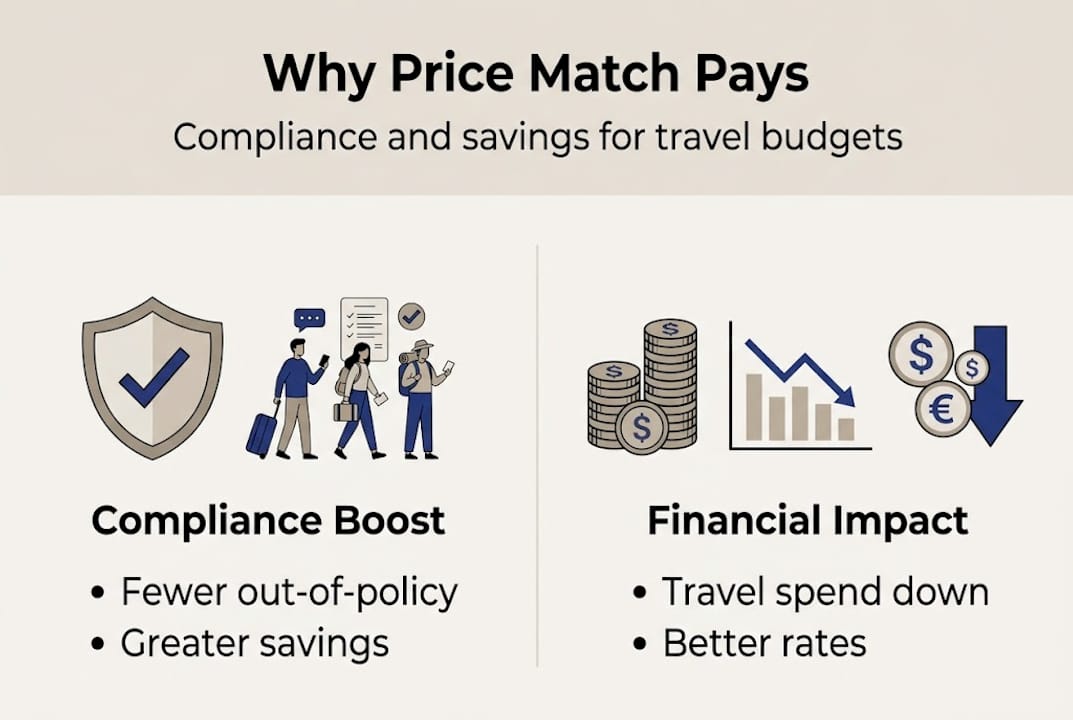
Corporate travel programs that combine negotiated rates with enforced price guarantees see total savings of 10-25% across their travel spend. Negotiated rates alone contribute 5-20%, but they only deliver if travelers actually book through approved channels. Price match is the mechanism that closes the gap between what was negotiated and what is actually paid.

The compliance angle is where price match earns its keep. Empirical research shows that policy compliance improves 12-18% when robust price guarantees are in place, and policy leakage drops by 3-6%. For mid-market companies, this translates to total savings of 15-25% when guarantees are actively enforced.
To make this concrete, consider a company with $2 million in annual travel spend:
| Scenario | Annual spend | Savings rate | Dollars saved |
|---|---|---|---|
| No price match, low compliance | $2,000,000 | 5% | $100,000 |
| Negotiated rates, moderate compliance | $2,000,000 | 12% | $240,000 |
| Negotiated rates plus price match | $2,000,000 | 20% | $400,000 |
That $160,000 difference between moderate and strong compliance is not theoretical. It reflects the real cost of travelers booking outside policy because they believe they found a better rate elsewhere.
Tracking luxury travel trends in 2026 also reveals that luxury hotel and airline pricing is increasingly dynamic. Rates shift daily, sometimes hourly. Without a price match safety net, your negotiated rates can look uncompetitive within days of being locked in, pushing travelers to book outside the program.
Pro Tip: Build a monthly compliance dashboard that tracks in-policy booking rates, average ticket prices, and price match claims used. This single habit can surface thousands of dollars in recoverable savings that most programs leave on the table. Connecting this data to improving group travel workflows makes the reporting even more actionable for large team trips.
How price matching drives policy compliance (and why that matters)
With cost impact clear, let’s examine the mechanics: why do price match policies boost compliance and what does that mean for your negotiating strength?
Travelers stray from approved booking channels for one primary reason: they think they can do better on their own. They find a rate on a consumer site that looks lower, and the path of least resistance is to book it directly. Price match eliminates that justification entirely. When travelers know that any lower qualified rate will be matched through the approved channel, there is no rational argument for booking outside the program.
The behavioral ripple effects are significant:
- Central booking increases because travelers no longer feel penalized for using the official channel.
- Data fidelity improves because all bookings flow through one system, giving you accurate spend data.
- Leakage drops because the most common excuse for off-policy booking disappears.
- Supplier relationships strengthen because your volume commitments become credible.
“Policy compliance improves 12-18% with robust price guarantees in place, directly amplifying the negotiating leverage travel managers hold with preferred hotel and airline partners.”
That last point about supplier relationships deserves emphasis. Airlines and hotels offer better rates to programs that demonstrate high, consistent volume. When your compliance rate rises, your negotiating position strengthens for the next contract cycle. Price match is not just a savings tool for today. It is a leverage builder for tomorrow.
Reviewing compliance strategies for executives confirms that the most effective programs combine price match with clear communication to travelers about how the policy works and why it benefits them personally. Travelers who understand the guarantee adopt it faster.
Pro Tip: Frame price match as a traveler benefit, not a control mechanism. When your team sees it as “we will always get you the best rate,” adoption climbs. Pair this messaging with incentive travel guidance to reinforce the culture of smart, rewarding travel choices.
Implementing price match: What to look for and common mistakes
Having seen the value and how compliance works, the next step is effective rollout. This is where many programs lose momentum.
Start by vetting providers carefully. Not all price match programs are created equal. Here is what to demand before signing:
- Verified, auditable rate sources: The provider must show exactly where the competing rate was found and confirm it was publicly available at time of claim.
- Defined claim windows: Know the exact timeframe within which a claim must be submitted. Ambiguity here kills adoption.
- Fast resolution: Claims resolved within 24 hours keep travelers confident. Slow processes breed workarounds.
- Scope documentation: Get in writing which travel categories are covered. Verbal assurances are not enough.
- Reporting access: You need claim history and compliance data, not just a promise that the policy exists.
Once you have selected a provider, implementation mistakes can still undermine results. The most common ones to avoid:
- Skipping traveler communication. If travelers do not know the guarantee exists, they will not use it.
- Failing to monitor compliance. Negotiated rates and price guarantees only deliver impact if compliance is tracked consistently.
- Ignoring claim data. Every claim tells you something about where your rates are losing competitiveness.
- Setting it and forgetting it. Rate environments shift. Review your price match terms at least quarterly.
- Treating all travel categories identically. Luxury hotel bookings behave differently from economy air. Tailor your approach accordingly.
Integrating price match into an existing program works best when you connect it to your broader planning incentive travel framework, ensuring that high-value group trips receive the same pricing discipline as routine business travel.
The overlooked upside: Why price match is a leadership tool
Most travel managers evaluate price match purely on cost reduction. That framing is too narrow, and it undersells the strategic value of what you are actually building.
When you implement a visible, enforced price match guarantee, you are sending a signal to your entire organization: this program is rigorous, transparent, and trustworthy. That signal matters more than most managers realize. Travelers who trust the program use it. Finance leaders who see the data support it. C-suite executives who understand the compliance gains fund it.
The contrarian view worth considering: price match is less a pricing tool and more a cultural one. It communicates that your travel program operates with the same discipline and accountability you would expect from any other business function. That credibility is hard to build and easy to lose.
We have seen this play out repeatedly over 35 years of managing luxury travel programs. The managers who win internal support are not the ones with the most complex negotiated rate structures. They are the ones whose programs travelers actually trust and use. A price match guarantee, clearly communicated and consistently enforced, is one of the fastest ways to build that trust.
If you are serious about customizing luxury travel experiences that reflect your organization’s standards, the pricing infrastructure behind those experiences must be just as intentional as the itinerary itself.
Unlock the value of a price match program for your next luxury journey
Translating price match principles into real savings requires more than a policy document. It requires a partner who knows how to enforce those guarantees across luxury hotels, premium airlines, and high-end ground services without losing the quality your travelers expect.
At Elite Travel Group, we offer a price match guarantee with zero service fees, available 24/7 for your team’s needs. Whether you are managing adventure travel packages for executive retreats or coordinating large-scale incentive programs, our concierge team ensures every booking reflects the best available rate. Explore our full approach to planning luxury vacations and see how 35 years of expertise translates into real budget confidence for your organization.
Frequently asked questions
What is travel policy leakage and how does price match help?
Leakage occurs when travelers book outside approved channels, eroding negotiated savings. Price match removes the rate-based justification for off-policy bookings, and leakage reduces 3-6% when strong guarantees are in place.
How do I verify if a price match was truly the best rate?
Demand transparent, auditable documentation from your provider for every claim, and require timely reporting so you can spot patterns and confirm accuracy across your full travel program.
Does price match apply to flights and hotels or just one?
Corporate price match programs can cover hotels, flights, or both depending on your agreement, so always review the scope clause carefully before finalizing any contract.
Should price match be the main factor in program selection?
No. Price match is one critical component, but service quality, compliance tools, supplier relationships, and reporting capabilities all contribute equally to a high-performing travel program.
What savings are realistic for mid-sized luxury travel programs?
Mid-market companies with enforced price guarantees achieve total savings of 15-25%, making it one of the highest-return investments available within a corporate travel budget.
Recommended
- Corporate travel management explained: streamline success in 2026
- How to plan corporate incentive travel that motivates
- Corporate travel trends 2026: Luxury insights (48% take 6+ trips)
- Domestic Vs International for Your Incentive Travel Trips | Elite Travel
