




Global business travel spending will exceed $1.5 trillion in 2026, yet most executives struggle with operational chaos, cost leakage, and traveler dissatisfaction. Corporate travel management transforms these challenges into competitive advantages through strategic planning, technology integration, and expert partnerships. This guide clarifies the fundamentals of corporate travel management to help you balance cost control, policy compliance, and luxury experience while boosting efficiency and employee satisfaction in 2026.
Table of Contents
- Why Corporate Travel Management Matters In 2026
- Major Challenges In Corporate Travel Management Today
- How Travel Management Companies Improve Corporate Travel Efficiency And Luxury Experience
- Best Practices For Effective Corporate Travel Management In 2026
- Explore Luxury Corporate Travel Options With Elite Travel
- Frequently Asked Questions About Corporate Travel Management
Key takeaways
| Point | Details |
|---|---|
| Strategic management drives revenue | Companies with structured travel programs report up to 30% higher revenue compared to peers without formal programs. |
| Traveler productivity suffers | Over a third of business travelers lose 4-8 hours of productive work per trip due to travel-related stress and inefficiencies. |
| Leakage undermines savings | Booking outside approved channels causes lost negotiated savings and incomplete data that erode program effectiveness. |
| Balance is critical | Effective programs balance cost-effectiveness, employee comfort, and policy compliance to maximize organizational value. |
| Expert partners streamline operations | Travel management companies calm operational chaos while elevating traveler experience and reducing administrative burden. |
Why corporate travel management matters in 2026
Corporate travel represents one of the largest controllable expenses for mid to large organizations. Global business travel spending continues rising despite economic uncertainty, reflecting travel’s irreplaceable role in building client relationships, closing deals, and maintaining competitive positioning. The sheer scale of this investment demands strategic oversight rather than ad hoc management.
Research demonstrates that companies with structured travel governance achieve up to 30% higher revenue than competitors lacking formal programs. This correlation isn’t coincidental. Well-managed travel programs enable faster market response, stronger stakeholder relationships, and more effective team deployment. They transform travel from a necessary cost into a strategic asset that drives measurable business outcomes.
Companies with a structured, well-governed approach to business travel report up to 30 percent higher revenue than peers without formal programs.
Effective corporate travel management delivers multiple organizational benefits:
- Enhanced cost control through negotiated rates, policy compliance, and spend visibility
- Improved traveler satisfaction via streamlined booking, personalized service, and duty of care
- Stronger data insights enabling smarter budgeting, forecasting, and strategic planning
- Reduced administrative burden freeing internal teams for higher-value work
- Better risk management through centralized tracking and 24/7 support infrastructure
Yet many organizations still treat travel as a tactical logistics function rather than a strategic business capability. This mindset leaves significant value on the table. The companies that recognize travel’s strategic importance and invest accordingly gain competitive advantages in talent retention, client relationships, and operational agility. For executives seeking to elevate their corporate incentive travel programs, understanding these fundamentals becomes essential to unlocking both efficiency and luxury experience.
Major challenges in corporate travel management today
Despite travel’s strategic importance, most organizations face persistent operational obstacles that undermine program effectiveness and traveler satisfaction. These challenges stem from fragmented systems, inadequate policies, and insufficient management attention.

Fragmentation and non-compliance leakage represent the most costly challenge. When employees book outside approved channels, companies lose negotiated discounts, miss duty of care visibility, and sacrifice the data needed for strategic planning. This leakage compounds over time, eroding program ROI and making accurate budgeting nearly impossible. Without centralized booking enforcement, travel managers operate blind to actual spending patterns and traveler behaviors.
Traveler productivity loss creates hidden costs that dwarf visible travel expenses. Research shows over a third of business travelers lose 4-8 hours of productive work time per trip due to travel stress, booking complexity, and logistical friction. Multiply those lost hours across hundreds of trips annually, and the opportunity cost becomes staggering. Fatigued travelers perform poorly in meetings, make suboptimal decisions, and return home depleted rather than energized.
Over a third of business travelers lose between four and eight hours of productive work time due to travel stress and operational inefficiencies.
Expense management friction compounds these problems. Manual expense processes lead to audit failures and employee frustration that damages morale and retention. When travelers spend hours documenting receipts, waiting for reimbursements, and navigating unclear policies, they view business travel as punishment rather than opportunity. This perception directly impacts willingness to travel and overall program participation.
Three operational pain points consistently emerge:
- Policy ambiguity causing confusion about approved vendors, spending limits, and booking procedures
- Technology gaps forcing travelers to juggle multiple platforms without integration or support
- Reactive management addressing problems after they occur rather than preventing them proactively
These challenges aren’t inevitable. They reflect organizational choices about investment priorities and management attention. Companies that address these obstacles systematically through clear policies, integrated technology, and expert partnerships transform travel from a source of friction into a competitive advantage. For travel managers developing a comprehensive corporate travel planning checklist, recognizing these challenges represents the first step toward building solutions that actually work.
How travel management companies improve corporate travel efficiency and luxury experience
Travel management companies calm the operational storm that overwhelms internal teams while elevating the traveler experience beyond what most organizations can deliver independently. These specialized partners bring technology platforms, supplier relationships, and operational expertise that transform travel from administrative burden into strategic capability.
Travel management companies provide comprehensive services addressing every aspect of corporate travel:
- Centralized booking platforms consolidating air, hotel, ground transportation, and ancillary services into single workflows that reduce complexity and improve compliance
- Negotiated supplier rates leveraging aggregate buying power to secure discounts individual companies cannot access independently
- Policy enforcement through technology guardrails preventing out-of-policy bookings while maintaining flexibility for legitimate exceptions
- Duty of care infrastructure tracking traveler locations, monitoring risk events, and enabling rapid response during disruptions
- Data analytics and reporting transforming raw transaction data into actionable insights for budgeting, forecasting, and strategic planning
- 24/7 traveler support resolving issues in real time regardless of time zone or location
Pro Tip: Most travel managers underestimate the compliance improvement achievable through travel management company partnerships. Companies typically see booking compliance rates jump from 60-70% to 85-95% within six months of implementation, directly translating to cost savings and data quality improvements.
| Aspect | DIY Management | Professional Travel Management Company |
|---|---|---|
| Cost savings | Limited to individual negotiations | 15-30% through aggregate buying power |
| Traveler satisfaction | Varies widely, often poor | Consistently high through expert service |
| Policy compliance | 60-70% typical | 85-95% achievable |
| Data visibility | Fragmented across systems | Centralized, actionable insights |
| Risk management | Reactive, manual tracking | Proactive monitoring and support |
| Administrative burden | High internal resource drain | Minimal, outsourced to experts |
The luxury experience dimension deserves special attention. Elite travel management companies don’t just reduce costs; they elevate the entire travel experience through personalized service, premium supplier relationships, and attention to detail that transforms business trips into opportunities for renewal rather than sources of stress. This dual focus on efficiency and experience explains why leading organizations increasingly partner with specialized firms rather than managing travel internally.
For executives looking to streamline corporate group travel workflows, understanding the role travel agencies play in delivering both operational excellence and luxury experience becomes critical to making informed partnership decisions.
Best practices for effective corporate travel management in 2026
Implementing a high-performing corporate travel program requires systematic attention to policy, technology, supplier relationships, and continuous improvement. These best practices reflect lessons from leading organizations that have transformed travel from cost center to strategic asset.
Successful programs share common elements that balance control with flexibility:
- Clear written policies defining approved suppliers, spending thresholds, booking procedures, and exception processes that employees actually understand and follow
- Integrated technology platforms eliminating the need to juggle multiple systems while providing mobile access for on-the-go booking and support
- Preferred supplier networks negotiated for both cost savings and service quality, regularly reviewed and optimized based on performance data
- Automated expense management reducing manual work, accelerating reimbursement, and improving audit compliance through digital receipt capture
- Regular traveler feedback collection through surveys and focus groups informing continuous program improvements aligned with actual user needs
- Executive sponsorship ensuring adequate budget, cross-functional cooperation, and organizational priority for travel program success
Pro Tip: Gaining executive buy-in for travel program investments requires framing proposals in business outcome terms rather than operational details. Focus presentations on projected ROI through cost savings, productivity gains, and risk reduction rather than platform features or process improvements. Quantify the current cost of inefficiency and present travel management as a profit center, not an expense.
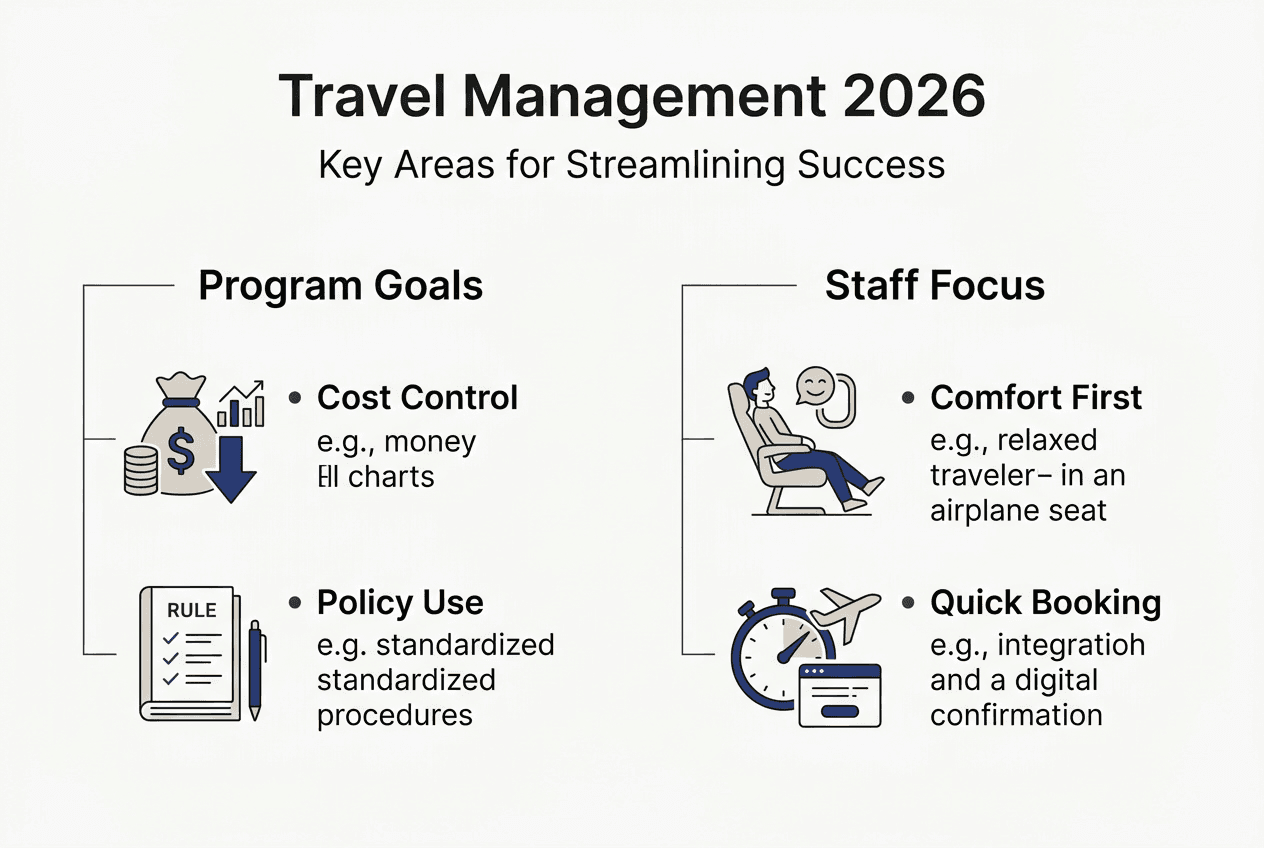
The challenge of balancing cost-effectiveness, employee comfort, and policy compliance intensifies in 2026 as hybrid work models reshape travel patterns and economic uncertainty pressures budgets. Organizations must track specific metrics to ensure their programs deliver intended value:
| Metric | Target Range | Measurement Frequency |
|---|---|---|
| Policy compliance rate | 85-95% | Monthly |
| Average cost per trip | Industry benchmark minus 10-15% | Quarterly |
| Traveler satisfaction score | 4.0+ out of 5.0 | Post-trip surveys |
| Booking lead time | 14+ days average | Monthly |
| Expense report cycle time | Under 5 days | Monthly |
| Duty of care incident response time | Under 2 hours | Per incident |
These metrics provide early warning signals when programs drift off track and enable data-driven optimization decisions. The most sophisticated organizations establish quarterly business reviews with travel management partners to analyze trends, identify improvement opportunities, and align program evolution with changing business needs.
For travel managers preparing compelling cases for program enhancements, learning how to propose travel incentives provides valuable frameworks applicable to broader travel management investments. The key lies in connecting operational improvements to measurable business outcomes executives care about: revenue growth, talent retention, and competitive positioning.
Explore luxury corporate travel options with Elite Travel
Transforming your corporate travel program from operational necessity to strategic advantage requires the right partner. Elite Travel Management Group brings 35 years of luxury travel expertise to corporate and incentive programs, delivering the personalized service and operational excellence that elevate both efficiency and traveler experience.

Our approach combines concierge-level attention with streamlined processes that simplify your travel management challenges. We handle every detail from initial planning through traveler support, ensuring your team experiences seamless, secure journeys that reflect your organization’s commitment to excellence. Whether you’re planning corporate incentive travel programs, executive retreats to luxury European destinations, or adventure travel experiences that inspire and reward your team, Elite Travel delivers the expertise and support that transform business travel from cost center to competitive advantage. Contact us to discover how our luxury travel solutions can elevate your corporate travel program while reducing your administrative burden.
Frequently asked questions about corporate travel management
What are the key components of an effective corporate travel policy?
An effective policy clearly defines approved booking channels, spending limits by trip type and seniority level, preferred supplier networks, advance booking requirements, and exception approval processes. The policy should be accessible, written in plain language, and regularly updated to reflect changing business needs and traveler feedback.
How does corporate travel management impact employee productivity?
Well-managed travel programs minimize friction through streamlined booking, reduce stress via reliable support, and enable travelers to focus on business objectives rather than logistics. Poor travel management costs organizations 4-8 hours of productive time per trip through booking complexity, travel stress, and expense reporting burdens that compound across hundreds of annual trips.
What technology tools support modern travel management?
Modern programs leverage online booking platforms integrating air, hotel, and ground transportation; mobile apps providing on-the-go access and real-time updates; automated expense management systems with digital receipt capture; traveler tracking for duty of care; and analytics dashboards transforming transaction data into actionable insights for continuous improvement.
How can companies reduce travel leakage?
Reducing leakage requires enforcing centralized booking through technology controls, communicating policy benefits clearly to travelers, making approved channels easier to use than alternatives, tracking compliance metrics and addressing patterns proactively, and partnering with travel management experts who provide superior service that naturally encourages compliance.
How do you measure ROI on corporate travel programs?
Travel program ROI encompasses hard savings through negotiated rates and reduced leakage, soft savings via productivity gains and reduced administrative burden, risk mitigation value from duty of care capabilities, and strategic value from improved client relationships and faster market response. Track total travel spend per revenue dollar, cost per trip versus benchmarks, traveler satisfaction scores, and policy compliance rates to quantify program effectiveness.
What role do travel management companies play in duty of care?
Travel management companies provide centralized traveler tracking, real-time risk monitoring, 24/7 emergency support, rapid rebooking during disruptions, and communication infrastructure connecting organizations with traveling employees during crises. This duty of care capability reduces organizational liability while demonstrating commitment to employee wellbeing that strengthens retention and travel program participation.
Recommended
- Streamline corporate group travel workflows in 2026
- Corporate incentive travel: A 2026 luxury guide
- Corporate travel planning checklist for luxury executives
- How to organize luxury group travel in 2026
