




TL;DR:
- A guest travel coordination workflow is essential for organizing group travel logistics and preventing delays. Centralized guest data, clear responsibilities, and automation form the foundation for smooth event execution. Proper planning and communication improve guest experience and reduce last-minute issues.
A guest travel coordination workflow is the structured process event planners use to organize, track, and execute all travel logistics for group events, from the first flight booking to the final transfer home. Without a defined process, even experienced coordinators face cascading delays, duplicate data, and frustrated guests. The industry term for this discipline is “group travel logistics management,” and it covers travel itinerary management, vendor coordination, guest data centralization, and real-time communication. For planners managing destination weddings, VIP retreats, or milestone celebrations, a tight workflow is the difference between a flawless event and a preventable crisis.
What are the essential prerequisites for a guest travel coordination workflow?
The foundation of any effective guest travel coordination workflow is clean, centralized guest data. Before you book a single transfer or send one itinerary, you need a single record per guest that includes contact details, travel preferences, dietary restrictions, and accommodation requirements. Centralized guest profiles that link itinerary, bookings, and suppliers give your team the operational clarity to respond quickly when anything changes.
Technology selection comes next. You need a collaboration platform that your whole team can access in real time, not a collection of individual spreadsheets. Assign clear ownership for each task category: one person owns flight tracking, another owns ground transport, and a third owns vendor communications. Overlapping responsibilities create gaps and duplicate effort.
Vendor and partner contact management deserves its own protocol. Build a master contact list that includes primary and backup contacts for every hotel, transfer company, and on-site service provider. For planners coordinating events in European destinations, working with local travel partners who know the ground conditions reduces response time dramatically.
Pro Tip: Set up a shared communication channel, such as a dedicated Slack workspace or WhatsApp group, for your internal team only. Keep guest-facing communication on a separate channel so operational discussions never reach guests by accident.
- Collect confirmed guest data before any booking is finalized
- Assign one named owner per logistics category
- Build a vendor contact list with primary and backup numbers
- Choose one collaboration platform and require all team members to use it
- Establish communication protocols before the event cycle begins
How to build a guest travel itinerary management system step by step
Building a travel itinerary management system starts with confirmed data, not estimates. Collect finalized flight details, accommodation confirmations, and ground transport bookings before you build any itinerary document. Unconfirmed details create version-control problems that compound as the event date approaches.

Step 1: Consolidate all arrival and departure data. Pull every guest’s inbound and outbound travel into one master document. Flag arrivals that fall outside your planned transfer windows immediately.
Step 2: Group arrivals into staggered blocks. Grouping arrivals within 2-hour windows is the industry standard for optimizing group transport vehicle usage and avoiding excessive wait times. This single step prevents the most common day-of bottleneck for group events.
Step 3: Build individual guest profiles. Each profile should capture flight numbers, accommodation assignment, dietary needs, accessibility requirements, and any special requests. One profile per guest, updated in real time, is the only way to avoid check-in errors and access issues on event day.
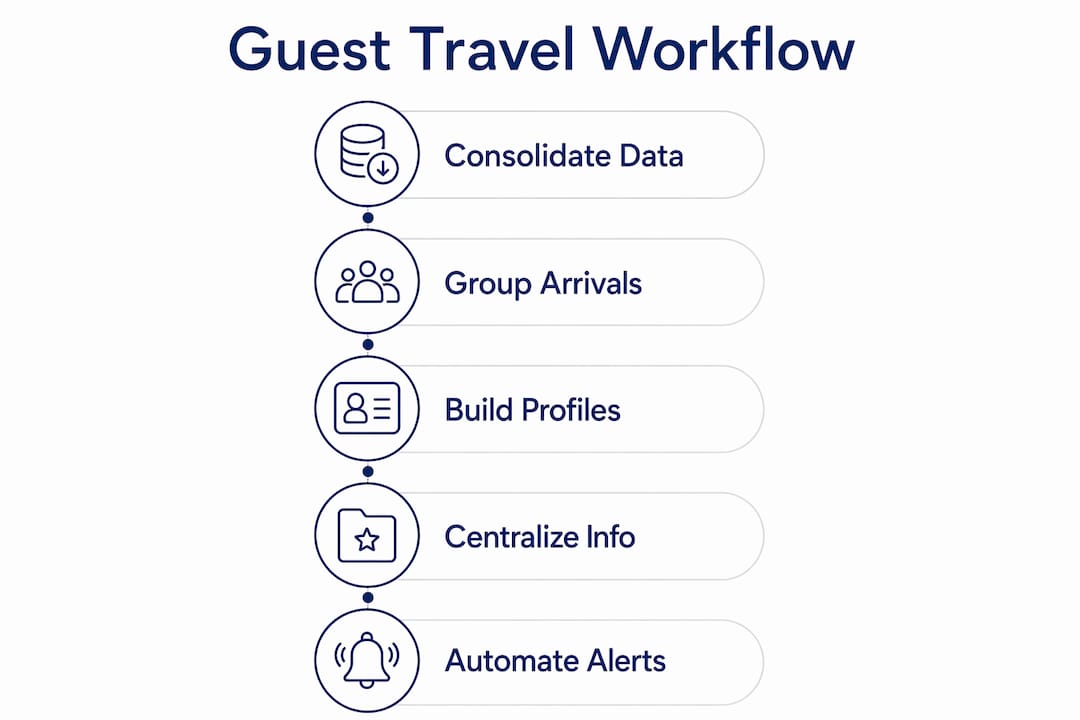
Step 4: Establish a single source of truth. One unified data source for registration and itinerary information reduces check-in errors and eliminates the confusion that comes from multiple team members working from different document versions.
Step 5: Activate automated alerts. Automated workflow triggers for deposit reminders, itinerary changes, and flight alerts free your team from manual tracking. Automation removes the human error that comes with repetitive status checks.
| Itinerary element | Owner | Update frequency |
|---|---|---|
| Flight details | Travel coordinator | Real time |
| Accommodation assignments | Logistics lead | Daily |
| Ground transport schedule | Transport manager | Every 6 hours on event day |
| Dietary and special requests | Guest services lead | At registration close |
Pro Tip: Lock your guest profile data 72 hours before the event. After that point, changes go through a single designated coordinator only. This prevents last-minute edits from creating conflicting versions across your team.
How to coordinate guest transportation and vendor logistics
Guest transportation workflow planning requires separating three distinct flows: guests, vendors, and staff. Mixing these flows at a single entry point creates congestion that delays everyone. Assign dedicated entry points and loading zones for each group before the event day.
Vendor arrival windows staggered by at least 30 minutes prevent loading dock congestion and the cascading delays that follow. A catering truck and an AV crew arriving simultaneously at a single dock will cost you an hour of setup time. Stagger arrivals on a written schedule and confirm each vendor’s window 48 hours in advance.
Guest transport capacity must align with your actual group size, not your registered headcount. Build in a 10–15% buffer for late arrivals and guests who miss their assigned transfer window. For rural or destination venues, GPS-based transport instructions reduce guest confusion far more effectively than street addresses alone.
Contingency planning is not optional. Every transport plan needs a documented backup for the three most likely failures: a vehicle breakdown, a flight delay affecting a large arrival group, and a venue access issue. Assign one team member as the contingency coordinator whose only job on event day is managing exceptions.
- Separate guest, vendor, and staff entry points at the venue
- Stagger vendor arrivals by a minimum of 30 minutes per slot
- Assign dock and entry points in writing to every vendor
- Build transport capacity with a buffer above confirmed headcount
- Document contingency plans for vehicle failure, flight delays, and access issues
| Transport scenario | Standard plan | Contingency plan |
|---|---|---|
| On-time group arrival | Scheduled shuttle fleet | N/A |
| Flight delay over 90 minutes | Flexible transfer window | On-call backup vehicle |
| Venue access issue | Primary entry point | Secondary entry with staff escort |
| Oversized arrival group | Confirmed capacity plus buffer | Additional vehicle on standby |
What communication strategies improve guest experience?
Proactive communication reduces guest anxiety and keeps your team out of reactive mode. Luxury event experts confirm that hospitality-focused, pre-emptive communication is the single most effective tool for smooth operations. Send a pre-event communication package at least one week before arrival that includes transport instructions, accommodation details, and a named contact for questions.
Offline-accessible content matters more than most planners expect. Guests traveling internationally may lose mobile data at the worst possible moment. Provide a downloadable PDF itinerary and a printed card with emergency contact numbers. Do not rely entirely on app-based or cloud-based delivery for critical logistics information.
Broadcast messaging through group SMS or WhatsApp lists works well for real-time updates on the day of the event. Keep these messages short, factual, and limited to logistics changes. Guests do not need a narrative; they need the updated pickup time and the correct gate number.
Pro Tip: Assign a dedicated “guest concierge” contact number that goes to one team member’s phone on event day. Publish this number in every pre-event communication. Guests who have a direct line to a real person are far less likely to escalate minor issues into major disruptions.
- Send a pre-event logistics package at least 7 days before arrival
- Provide offline-accessible itinerary documents for international guests
- Use broadcast messaging for real-time day-of updates only
- Publish a single emergency contact number in all guest communications
- Confirm transport instructions with GPS coordinates for destination venues
What common mistakes should you avoid in guest travel coordination?
The most damaging mistake in guest logistics planning is treating each task as an isolated checklist item. Logistics dependencies are interconnected, and quality planning is determined in the first weeks by mapping those dependencies, not by completing tasks in sequence. A delay in finalizing catering counts, for example, directly affects transport scheduling, room assignments, and vendor arrival windows.
- Failing to freeze critical dependencies early. Catering counts, room block confirmations, and transport capacity must be locked before other planning can proceed. Leaving these open creates a chain of downstream errors.
- Maintaining multiple guest data records. Duplicate profiles for the same guest produce conflicting information at check-in. One record per guest, updated by one designated owner, is the only reliable approach.
- Overlapping vendor arrival windows. Two vendors scheduled for the same dock at the same time will cause a delay that affects every subsequent setup task.
- Ignoring tech failure scenarios. Every digital system needs an offline backup. Print your master guest list, transport schedule, and vendor contact sheet the night before the event.
- Skipping the post-event review. Every event produces data on what broke down and why. A 60-minute debrief after the event creates the institutional knowledge that makes your next workflow faster and more reliable.
The quality of your event logistics is determined in the planning phase, not on event day. By the time guests arrive, your only job is executing a plan that was built to absorb the unexpected.
For planners managing luxury group travel at scale, the stakes of these mistakes are higher. A missed transfer for a VIP guest at a destination wedding is not a minor inconvenience. It is a reputational event.
Key Takeaways
A guest travel coordination workflow succeeds when it combines centralized data, staggered logistics, proactive communication, and clearly assigned ownership across every task category.
| Point | Details |
|---|---|
| Start planning early | Events with 200+ guests require at least 10–12 weeks of lead time to coordinate logistics effectively. |
| Centralize all guest data | One profile per guest, updated in real time, eliminates check-in errors and conflicting information. |
| Stagger arrivals and vendors | Group guest arrivals in 2-hour windows and stagger vendor slots by 30 minutes to prevent congestion. |
| Communicate proactively | Send a pre-event logistics package at least 7 days out and provide offline-accessible documents for all guests. |
| Map dependencies, not checklists | Treat logistics as interconnected tasks; freeze critical dependencies like catering counts before other planning proceeds. |
What I’ve learned after years of coordinating group travel
The conventional wisdom says the hardest part of group travel coordination is the day of the event. After years of managing complex group itineraries, I disagree. The hardest part is the six weeks before, when every stakeholder has a different version of the plan and no one has committed to a single source of truth.
The planners who execute flawlessly on event day are the ones who had one brutal alignment meeting early in the process. They forced every vendor, hotel contact, and internal team member to confirm their role, their data, and their escalation path. That meeting feels like a waste of time when the event is still two months away. It saves you three hours of crisis management on the day itself.
The other lesson I keep relearning is that flexibility and structure are not opposites. The most adaptable coordinators I know are also the most disciplined about documentation. They can absorb a last-minute flight change because their contingency plan is already written down. They can reassign a guest’s transfer because the profile is current and accessible. Structure is what makes flexibility possible.
For planners new to concierge-level travel coordination, the instinct is to add more tools and more communication channels. The better instinct is to reduce them. One platform. One contact per function. One document that everyone trusts. Simplicity at the system level is what produces a complex, beautiful guest experience at the event level.
How Elitetravelgroup supports your group travel planning
Event planners managing high-stakes group travel need more than a checklist. They need a partner who has already solved the problems they are about to face.
Elitetravelgroup brings 35 years of luxury group travel expertise to every coordination challenge, from custom group itineraries for destination weddings to VIP retreat logistics across Europe, Asia, and beyond. The team manages real-time itinerary updates, vendor coordination, and 24/7 travel support so last-minute changes never reach your guests as disruptions. With no service fees and a price match guarantee, Elitetravelgroup gives event planners a professional partner who handles the logistics while you focus on the experience. Explore luxury group travel packages built for events that demand precision and elegance.
FAQ
What is a guest travel coordination workflow?
A guest travel coordination workflow is the structured process for organizing, tracking, and executing all travel logistics for group event guests. It covers itinerary management, transport scheduling, vendor coordination, and guest communication from pre-arrival through departure.
How far in advance should I start planning guest travel logistics?
Events with 200 or more guests require a minimum of 10–12 weeks of lead time. Complex multi-venue or international events need at least 6 months to coordinate all dependencies effectively.
How do I manage last-minute changes in a guest travel coordination workflow?
Assign one designated coordinator to handle all day-of changes and maintain an offline backup of your master guest list and transport schedule. Automated alerts for flight changes and a single emergency contact number for guests reduce the impact of unexpected disruptions.
What is the best way to organize guest transportation for a group event?
Group arrivals within 2-hour windows optimize vehicle usage and reduce wait times. Provide GPS-based transport instructions rather than street addresses, especially for destination or rural venues.
Why does centralized guest data matter for event coordination?
A single, unified guest profile connecting itinerary, bookings, and supplier details reduces check-in errors and gives your team the real-time accuracy needed to respond when plans change. Multiple data sources create conflicting information that causes preventable mistakes on event day.
