



TL;DR:
- A destination wedding involves traveling to an away location and hosting a multi-day celebration. It generally features fewer guests and requires extensive planning, often resulting in lower overall costs. Choosing a location that reflects your personality and prioritizing local expertise are key to a successful event.
A destination wedding is a wedding ceremony and reception held away from the couple’s hometown, requiring guests to travel and creating an immersive, multi-day celebration experience. Unlike a standard local wedding, the location itself becomes a central part of the event. Destination weddings represent approximately 25% of global weddings in early 2026. That share reflects a clear shift: couples are choosing experience over convention. Planning typically spans 12–18 months, and guest counts usually fall between 30 and 75 people. Whether you are considering a cliffside ceremony in Santorini, a vineyard celebration in Tuscany, or a mountain lodge in Colorado, the destination wedding definition centers on one thing: travel transforms the event into a shared experience for everyone present.
What is a destination wedding vs. a traditional local wedding?
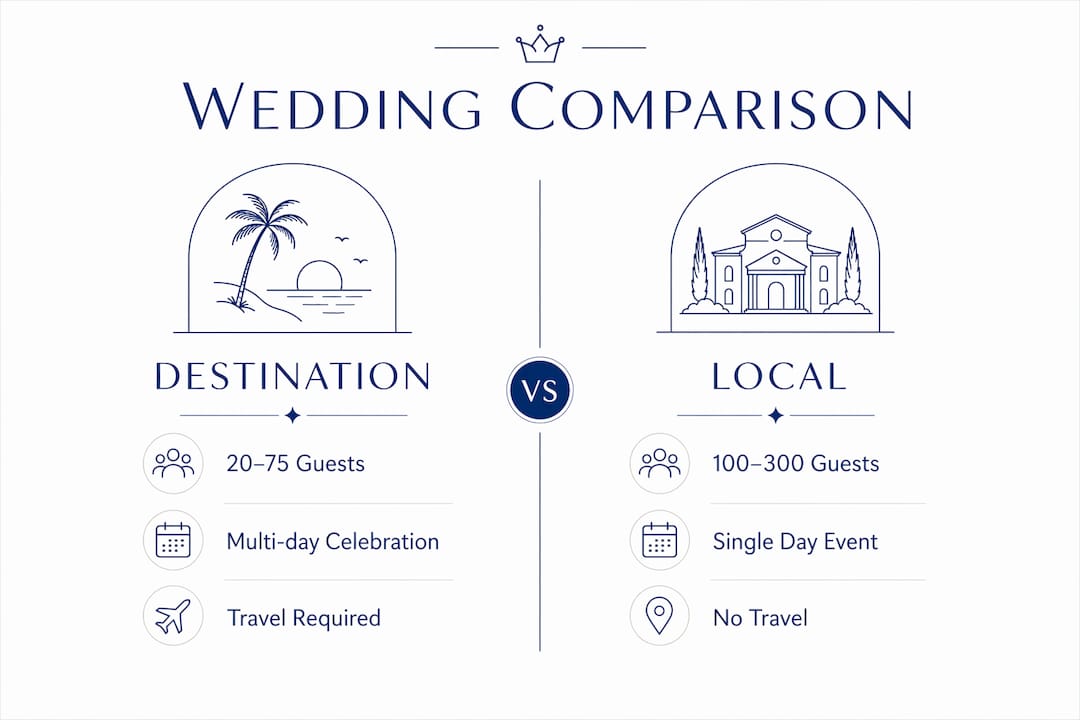
A destination wedding differs from a traditional wedding in scale, atmosphere, and planning complexity. The most immediate difference is the guest list. Travel acts as a natural filter, producing more intimate gatherings of 20–50 guests compared to the larger crowds typical of local weddings. Fewer guests means more intentional design choices and a tighter, more personal celebration.

The planning process is also fundamentally different. Local weddings center on vendor coordination within a familiar city. Destination wedding planning adds layers: international travel logistics, accommodation blocks, legal marriage requirements, and multi-day event programming. Couples planning a wedding abroad must account for guest travel schedules, time zone differences, and currency considerations that simply do not apply at home.
Cost is where the comparison gets interesting. 62% of destination wedding couples spend less overall than they would on a traditional wedding. A smaller guest list cuts catering and venue costs significantly. That savings can be redirected toward a higher-quality experience: a private villa, a chef-driven dinner, or a sunset boat excursion for the whole group.
Pro Tip: Book an all-inclusive resort or private villa that handles catering, accommodation, and event space in one contract. This single move eliminates the need to coordinate multiple vendors across time zones and reduces the risk of last-minute surprises.
| Feature | Destination Wedding | Traditional Local Wedding |
|---|---|---|
| Guest count | 20–75 guests | 100–300+ guests |
| Planning timeline | 12–18 months | 6–12 months |
| Location role | Central to the experience | Backdrop only |
| Cost per guest | Higher | Lower |
| Overall spend | Often lower (smaller list) | Often higher |
| Guest experience | Multi-day, immersive | Single-day event |
How has the destination wedding definition evolved in 2026?
The destination wedding definition has expanded well beyond tropical beaches and European castles. The rise of domestic destination weddings, sometimes called “domestination” weddings, has reshaped what qualifies. Only 18% of destination weddings in 2024 were tropical, and just 14% were held in a different country. The majority took place at domestic locations that simply required guests to travel.
The defining factor is not distance. The intentional creation of an immersive experience is what separates a destination wedding from a local one. A wedding at a remote Montana ranch or a historic Georgia plantation requires the same travel mindset as one in Bali or the Amalfi Coast. Guests book flights, reserve hotel rooms, and clear their calendars for multiple days.
Couples in 2026 are choosing locations that reflect their personalities rather than defaulting to the most photographed spots. Popular destination wedding locations now include:
- Mountain lodges in Colorado, Vermont, or the Swiss Alps for winter and fall ceremonies
- Vineyards and wineries in Napa Valley, Tuscany, or the Douro Valley in Portugal
- Private estates and chateaux in France, Ireland, and the English countryside
- Desert settings in Arizona, New Mexico, and Morocco
- Coastal cliffs and islands in Greece, Croatia, and the Caribbean
- Urban rooftops and historic buildings in cities like New York, Paris, and Rome
Each of these settings turns the wedding into a multi-day celebration that typically runs 2–4 days. Guests do not just attend a ceremony. They share meals, explore the location, and build memories together across the entire trip.
What legal and logistical factors matter most when planning a destination wedding?
Legal marriage requirements are the most overlooked part of destination wedding planning. Legal marriage abroad often requires months of paperwork preparation, possible residency periods, civil ceremony attendance, and document authentication. Requirements vary widely by country. Italy, for example, requires apostille-certified documents and advance notice to local civil authorities. Mexico requires blood tests and notarized translations of birth certificates.
Many couples sidestep this complexity by legally marrying at home before or after the destination event. The destination ceremony becomes a symbolic celebration. This approach is legally clean, emotionally satisfying, and far less stressful to coordinate from abroad.
Expert wedding planners recommend hiring local destination planners who know the vendors, the laws, and the venue logistics firsthand. A local planner in Positano knows which florists deliver to clifftop venues. A coordinator in Cancun knows which resorts have noise ordinances after 10 p.m. That on-the-ground knowledge is irreplaceable.
Here are the core planning steps for a destination wedding:
- Set your location and vision at least 18 months before the wedding date.
- Research legal requirements for marriage in your chosen country or state.
- Hire a local wedding planner or resort coordinator with verified destination experience.
- Send save-the-dates to guests at least 12 months in advance to allow travel planning.
- Negotiate room blocks at nearby hotels across multiple price points for guest flexibility.
- Build a wedding website with travel guides, accommodation options, and a detailed itinerary.
- Confirm all vendor contracts with clear cancellation and weather contingency clauses.
- Communicate early and often with guests about travel logistics, dress codes, and local customs.
Pro Tip: If you are marrying in a foreign country, consult an immigration attorney or the country’s consulate at least 12 months out. Some countries require residency of several days before a legal ceremony. Knowing this early prevents costly itinerary changes.
You can also review domestic vs. international considerations to weigh the logistical tradeoffs before committing to a location.
How do you choose the right destination and venue?
The right destination aligns your vision, your guests’ travel needs, and the practical realities of the location. Treating the wedding as a group vacation is the most useful mental shift you can make. Every location decision should pass one test: will this work for the people you are asking to travel?
Venue type shapes the entire experience. All-inclusive resorts in the Caribbean and Mexico offer built-in catering, accommodation, and event coordination under one roof. Private villas in Italy or France offer exclusivity and a more personal atmosphere but require sourcing every vendor independently. Understanding types of destination weddings helps you match the venue format to your priorities before you start comparing prices.
Use these criteria to evaluate any potential destination:
- Accessibility: Direct flights from your guests’ home cities reduce travel fatigue and dropout rates.
- Climate and season: Research the rainy season, hurricane windows, and peak tourist crowds for your target month.
- Accommodation range: Guests have different budgets. A destination with options from boutique hotels to luxury resorts serves everyone.
- Vendor ecosystem: Established wedding destinations like Tuscany, Riviera Maya, and Santorini have experienced local vendors. Remote locations may require importing vendors at significant cost.
- Legal simplicity: Domestic destinations eliminate foreign marriage law complexity entirely.
- Aesthetic fit: The setting should feel like an extension of your relationship, not just a backdrop chosen for Instagram.
Scouting the location in person before booking is worth the cost of a trip. Photos do not capture noise levels, crowd density, or the actual view from the ceremony spot. A site visit also lets you meet potential vendors face to face, which builds trust and reduces miscommunication.
Key Takeaways
A destination wedding is defined by the intentional creation of an immersive, multi-day experience for guests, not simply by travel distance or an exotic location.
| Point | Details |
|---|---|
| Core definition | A destination wedding requires guest travel and centers the location as part of the experience. |
| Guest list size | Expect 20–75 guests; travel naturally produces a more intimate, design-focused celebration. |
| Planning timeline | Start 12–18 months out to manage legal, logistical, and travel coordination effectively. |
| Legal complexity | Many couples legally marry at home and hold a symbolic ceremony at the destination. |
| Cost reality | 62% of destination wedding couples spend less overall due to smaller guest counts. |
Why the “location-first” mindset changes everything
The biggest mistake I see couples make is choosing a destination for the photos and then trying to retrofit a wedding around it. The location-first mindset works in reverse: you choose a place that genuinely reflects who you are as a couple, then build every detail outward from that core.
I have worked with couples who chose a remote Amalfi Coast villa because it looked stunning in a magazine. They spent months fighting with vendors who did not speak English, navigating narrow roads that made floral deliveries nearly impossible, and managing guests who resented the 14-hour travel day. The wedding was beautiful. The planning process was brutal.
Contrast that with a couple who chose a vineyard in Sonoma, California. Domestic flights, familiar vendors, no legal paperwork complications, and a guest list that actually showed up. The intimacy of 40 people sharing three days among the vines created something no 200-person ballroom wedding could replicate. The wedding travel management side of things ran cleanly because the logistics were manageable from the start.
My honest advice: treat your destination wedding as a hosted vacation first and a wedding second. Your job is to make your guests feel taken care of from the moment they book their flights. Clear communication, a well-organized wedding website, and a local planner who knows the territory are not optional extras. They are the foundation. Get those three things right, and the rest of the planning falls into place.
How Elitetravelgroup handles destination wedding planning
Planning a destination wedding is one of the most rewarding things a couple can do. It is also one of the most logistically demanding.
Elitetravelgroup has 35 years of experience coordinating luxury destination weddings across Europe, the Caribbean, Mexico, and beyond. The team manages everything from destination wedding packages and accommodation blocks to on-the-ground vendor coordination and legal guidance. Elitetravelgroup charges no service fees and offers a price match guarantee, so you get expert support without paying a premium for it. Whether you are planning an intimate ceremony in the Swiss Alps or a multi-day celebration on the Amalfi Coast, Elitetravelgroup connects you with the right people in the right places to make it work. Reach out any time. The team is available 24/7.
FAQ
What is a destination wedding, exactly?
A destination wedding is a wedding held away from the couple’s hometown that requires guests to travel, typically spanning 2–4 days and centering the location as a core part of the experience.
How far in advance should you plan a destination wedding?
Most destination wedding planners recommend starting 12–18 months before the wedding date to allow time for legal requirements, vendor booking, and guest travel coordination.
Do destination weddings have to be international?
No. 18% of destination weddings in 2024 were held in a different country, while the majority took place at domestic locations that simply required guests to travel.
Are destination weddings cheaper than traditional weddings?
They can be. 62% of destination wedding couples spend less overall, primarily because smaller guest lists reduce catering and venue costs significantly.
Do you need a local wedding planner for a destination wedding?
Yes. Local planners know the vendors, the legal requirements, and the venue logistics that remote coordination cannot replicate. For international weddings especially, a local coordinator is the single most important hire you will make.
Recommended
- Types of Destination Weddings: Your Planning Guide
- What Is Destination Management? Your 2026 Guide
- Types of Honeymoon Destinations: Your 2026 Guide
- Luxury Honeymoon Booking: Step-by-Step Guide 2026
