




TL;DR:
- A curated itinerary is a personalized travel plan designed around an individual’s interests, needs, and style instead of a generic schedule. It offers genuine customization, including mobility, dietary, and sensory preferences, with built-in flexibility and better pacing, enhancing the travel experience. Travelers should prepare detailed preferences and collaborate closely with designers to avoid pitfalls like over-scheduling and to maximize the benefits of truly personalized trips.
A curated itinerary is a personalized travel plan built around your specific interests, pace, budget, and needs rather than a generic schedule anyone could follow. In the travel industry, this concept is also called “bespoke travel” or “custom travel design.” The defining feature is intentional selection. Every hotel, activity, and transfer is chosen because it fits you, not because it fills a slot on a template. Travel advisors deliver hyper-detailed planning tailored entirely to a traveler’s unique personality and priorities, which is what separates a curated plan from a standard package tour.
What is a curated itinerary, and how does it differ from a generic one?
A generic itinerary is a chronological list of places and times. It tells you where to be and when, but it knows nothing about you. A curated itinerary, by contrast, is built on a foundation of your preferences, constraints, and travel style.

Genuine curation incorporates specific constraints like sensory needs, dietary requirements, and mobility limitations. That level of detail is what separates real personalization from repackaged marketing. Industry experts warn travelers to verify that planners embed this depth of customization rather than simply relabeling a standard tour as “curated.”
The table below shows the clearest distinctions between the two approaches.
| Feature | Generic itinerary | Curated itinerary |
|---|---|---|
| Built around traveler preferences | No | Yes |
| Accounts for mobility or dietary needs | Rarely | Always |
| Includes local insider knowledge | Seldom | Standard |
| Pacing adjusted to traveler energy | No | Yes |
| Flexibility built in | No | Yes |
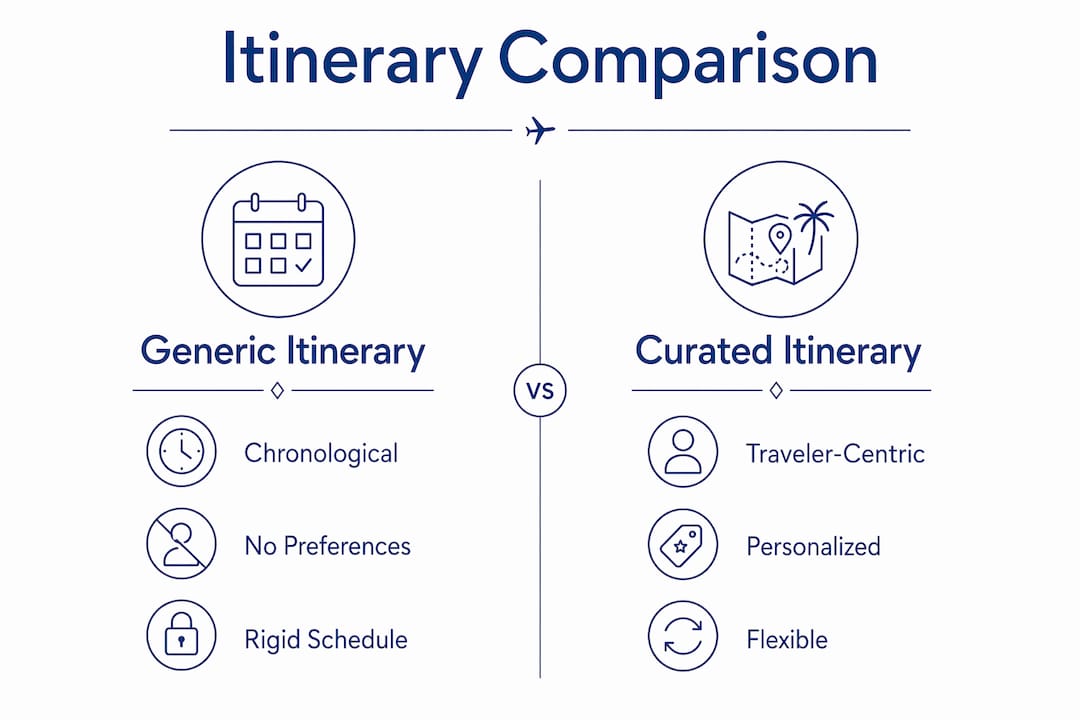
The practical difference shows up on day three of a trip. A generic plan keeps moving regardless of how you feel. A curated plan has buffer time, alternative options, and a designer who already knows your limits.
What are the benefits of a curated trip?
The benefits of curated trips go well beyond convenience. The most significant advantage is that the trip actually reflects who you are and what you value.
- Personalized experiences. Every activity, restaurant, and hotel is selected to match your interests, whether that means art museums in Florence, surf breaks in Bali, or private wine tastings in Burgundy.
- Better pacing. A well-designed plan avoids cramming too much into each day. Experienced travelers know that pacing prevents exhaustion and preserves enjoyment throughout the trip.
- Insider access. Travel designers maintain relationships with local guides, boutique properties, and experience providers that are not available through standard booking platforms.
- Reduced stress. When logistics are handled by an expert, you spend your mental energy on the trip itself, not on troubleshooting transfers or hunting for reservations.
- Adaptability. A curated plan is a living document. If weather changes or a new opportunity appears, a good designer adjusts without derailing the whole schedule.
- Reduced burnout. Travelers who follow curated plans report fewer regrets because the plan was never trying to do too much in the first place.
Pro Tip: When evaluating a travel designer or agency, ask specifically how they handle unexpected changes mid-trip. The answer reveals whether they offer real support or just a PDF document.
The benefits of personalized travel compound over the course of a trip. A single well-chosen hotel can anchor an entire day’s experience in a way that a generic pick never could.
How is a curated itinerary created?
The creation process follows a clear sequence. Understanding it helps you participate more effectively and get a better result.
- Initial consultation. Travel designers start with a deep conversation about your personality, priorities, travel history, and budget. This is not a form to fill out. It is a dialogue that shapes every decision that follows.
- Budget mapping. Budget is a primary filter that structures the entire plan. Costs are divided across flights, accommodation, activities, transportation, and a contingency reserve. Setting these parameters early prevents overruns and keeps the plan realistic.
- Experience research and selection. The designer identifies hotels, guides, restaurants, and activities that match your profile. This step draws on both database research and personal relationships with on-the-ground partners.
- Geographic grouping. Grouping activities by neighborhood reduces backtracking and travel fatigue. A well-structured day flows through one area rather than zigzagging across a city.
- Pacing and daily structure. Each day is built with a rhythm: one or two anchor activities, supporting experiences, meals, and open time. This prevents the schedule from becoming a checklist.
- Review and refinement. You review the draft, flag anything that does not fit, and the designer adjusts. This back-and-forth is where the plan becomes truly yours.
- Confirmation and documentation. Reservations are confirmed, contact details for local partners are compiled, and the final plan is delivered in a format you can use on the road.
Pro Tip: Schedule your highest-energy activities for the first two days of any trip. Jet lag and travel fatigue hit hardest by day four, so front-loading the demanding experiences protects the rest of the plan.
Working with a luxury travel agency means this process is handled by someone who has done it hundreds of times. The difference in output quality is significant compared to building a plan from scratch using general travel websites.
How can travelers personalize curated itineraries to reflect their preferences?
Personalization works best when you come prepared. The more specific your input, the more precisely the plan can reflect your actual travel style.
Share details across these categories before your first consultation:
- Activity preferences. Do you prefer active experiences like hiking and cycling, or slower cultural immersion like museum visits and cooking classes?
- Dietary needs. Allergies, intolerances, and cuisine preferences all affect restaurant selection and meal planning.
- Mobility considerations. Any physical limitations should be disclosed early so the designer can select accessible venues and appropriate walking distances.
- Sensory preferences. Some travelers prefer quiet, uncrowded experiences. Others thrive in lively markets and busy neighborhoods. Both are valid and both require different planning.
- Budget priorities. Where do you want to spend more and where are you comfortable with less? Some travelers prioritize accommodation; others invest in unique experiences.
Collaborative planning between traveler and designer produces the best results. The designer brings destination expertise; you bring self-knowledge. Neither alone is sufficient.
A well-structured plan also allocates about 60% of each day to planned activities and leaves 40% open for improvisation. That open time is not wasted. It is where the most memorable moments of a trip often happen.
Pro Tip: Start your relationship with a new travel designer by asking them to handle one hotel booking before committing to a full itinerary. That single transaction reveals their communication style, attention to detail, and responsiveness under real conditions.
Curated group travel follows the same personalization principles but adds the complexity of aligning multiple travelers’ preferences. A skilled designer handles this without defaulting to the lowest common denominator.
Common pitfalls to avoid when using a curated itinerary
Even a well-designed plan can fail if travelers make predictable mistakes during execution. The most common errors are avoidable with a little awareness.
Anchor saturation is the leading cause of trip burnout. It happens when too many high-intensity, reservation-based activities are stacked into a single day. Experienced travelers limit these to one or two per day, leaving room for the trip to breathe.
| Pitfall | Why it happens | Best practice |
|---|---|---|
| Anchor saturation | Trying to maximize every hour | Limit high-intensity activities to 1–2 per day |
| No buffer time | Underestimating travel between venues | Add 30–45 minutes between each activity |
| Ignoring energy levels | Following the plan rigidly | Build in one low-key afternoon per three days |
| No contingency plan | Assuming everything goes as scheduled | Identify one backup option per major activity |
| Skipping the review step | Trusting the designer without checking | Read the full draft and flag anything unfamiliar |
The itinerary is a confidence framework, not a contract. Treating it as rigid removes the flexibility that makes curated travel superior to a package tour. The best travelers use the plan as a guide and stay open to what the destination offers beyond the schedule.
Expert group travel planning applies these same principles at scale, where the cost of a single pitfall multiplies across every traveler in the group.
Key Takeaways
A curated itinerary delivers superior travel experiences because it combines expert knowledge, genuine personalization, and built-in flexibility that generic plans cannot replicate.
| Point | Details |
|---|---|
| Definition of curation | A curated itinerary is built around your specific preferences, constraints, and travel style, not a generic template. |
| Personalization depth | Real curation incorporates mobility, dietary, sensory, and budget needs from the first consultation. |
| Creation process | The process runs from consultation and budget mapping through geographic grouping, pacing, and final review. |
| Flexibility is built in | The best plans allocate roughly 40% of each day to open time, preserving spontaneity and reducing burnout. |
| Avoid anchor saturation | Limit high-intensity activities to 1–2 per day to maintain energy and enjoyment throughout the trip. |
Why curated itineraries changed how I think about travel
I have reviewed hundreds of travel plans over the years, and the ones that genuinely transformed a traveler’s experience share one quality: they were built on a real conversation, not a form.
The most common mistake I see is travelers treating personalization as a preference checklist. They tick “beach” and “culture” and expect the designer to do the rest. The plans that actually deliver are the ones where the traveler shared something specific: they get overwhelmed in crowds by noon, they want to be near a great bakery every morning, they have a bad knee that makes cobblestones painful after two hours. Those details are not trivial. They are the architecture of a great trip.
What I find most interesting about the current direction of travel curation is the integration of local support networks. A premium transfer service that handles luggage between hotels, for example, can change the entire texture of a multi-city trip. It is the kind of detail that never appears on a generic itinerary but defines the experience on a curated one.
The travelers who get the most from curated planning are not necessarily the ones with the biggest budgets. They are the ones who show up to the first consultation knowing what they want and willing to say what they do not.
Elitetravelgroup’s approach to personalized travel planning
Elitetravelgroup has spent 35 years designing bespoke travel itineraries for travelers who want more than a standard package. The agency covers luxury adventure travel, incentive travel, destination weddings, honeymoons, and milestone celebrations across Europe and beyond.
Elitetravelgroup charges no service fees and offers a price match guarantee, so travelers book with confidence rather than compromise. The team is available 24/7, which matters when a flight changes at 11:00 PM or a reservation needs adjusting on the ground. For travelers ready to move from generic planning to a plan that actually fits their life, Elitetravelgroup’s adventure travel packages and Europe vacation packages are a strong starting point.
FAQ
What is a curated itinerary in simple terms?
A curated itinerary is a personalized travel plan built around your specific interests, pace, and needs. It differs from a standard itinerary because every element is intentionally selected to fit you, not a generic traveler.
How long does it take to create a curated itinerary?
The timeline depends on trip complexity, but most full itinerary designs take one to three weeks from initial consultation to final delivery. Simpler trips with fewer destinations can move faster.
Do I need a travel designer to have a curated itinerary?
A travel designer produces the most thorough results, but experienced travelers can build their own curated plans by applying the same principles: detailed self-assessment, geographic grouping, pacing, and built-in flexibility.
What is travel curation, and is it only for luxury travelers?
Travel curation is the practice of intentionally selecting every element of a trip to match a specific traveler’s profile. It applies at any budget level, though luxury agencies like Elitetravelgroup offer the deepest level of customization and on-the-ground support.
How do I avoid burnout on a curated itinerary?
Limit high-intensity, reservation-based activities to one or two per day and leave at least 40% of each day unscheduled. That open time prevents exhaustion and creates space for the unexpected moments that define great travel.
