


TL;DR:
- Incentive travel programs require strategic design beyond logistics to motivate employees effectively.
- Specialist agencies align trips with business goals, measure ROI, and enhance program impact.
- Combining group and individual incentives optimizes engagement, retention, and inclusivity.
Not every travel agency can run a high-impact incentive program. Many businesses assume that booking flights and hotels is the hard part, and that any agency can handle the rest. The reality is that incentive program strategy requires far more than logistics. It demands a deep understanding of what motivates people, how to tie experiences to business outcomes, and how to measure what worked. This guide breaks down what separates specialist agencies from generic ones, how to design programs that actually move the needle, and how to choose the right structure for your workforce.
Table of Contents
- Why travel agencies matter in incentive programs
- Comparing traditional travel agencies to incentive travel specialists
- Designing incentive programs for maximum impact
- Choosing between group and individual incentive travel
- The real value travel agencies can unlock
- Elevate your incentive program with a luxury travel partner
- Frequently asked questions
Key Takeaways
| Point | Details |
|---|---|
| Specialist agencies maximize impact | Not all travel agencies are equipped to design strategic incentive programs that truly drive engagement and KPIs. |
| Incentive travel boosts loyalty | Well-designed travel rewards outperform cash in retention, brand favorability, and overall satisfaction. |
| Choose the right model | Understanding the differences between group and individual incentives helps tailor programs to your organization’s needs. |
| Strategic partnership is key | Partnering with a specialist agency enables co-design, measurement, and continuous program improvement. |
Why travel agencies matter in incentive programs
The right travel partner does not just book trips. They shape experiences that your employees will talk about for years, and that your leadership team will point to when measuring engagement results. That distinction matters enormously when you are investing significant budget into a reward program.
At the foundational level, travel agencies bring three core assets to any incentive program:
- Supplier relationships: Access to preferred rates, exclusive room blocks, and VIP treatment at top-tier properties that are simply not available through standard booking channels.
- Destination expertise: Knowing which locations deliver the right atmosphere, which seasons to avoid, and which on-the-ground partners can execute flawlessly.
- Logistics management: Coordinating group air, transfers, hotel rooming lists, dietary requirements, and contingency planning so nothing falls apart mid-trip.
But here is where most organizations stop, and where they leave real value behind. Designing strategic incentive programs tied to business KPIs, ROI measurement, and customized motivational experiences is a different discipline entirely. A traditional agency may handle the logistics beautifully but never ask you what business problem you are trying to solve.
“The most effective incentive travel programs are built backwards from a business outcome, not forward from a destination brochure.”
Specialist agencies approach incentive travel packages with a strategic lens. They start with your goals: Are you trying to reduce turnover? Accelerate sales performance? Strengthen culture after a merger? The destination, format, and experience design all flow from that answer.
They also bring critical support functions that generic agencies rarely offer. Risk management protocols, travel insurance structuring, compliance with corporate travel policies, and cost optimization through multi-vendor negotiation are all part of the specialist toolkit. When you are planning incentive trips for high performers, every detail reflects your brand. Getting those details right is not optional.
Comparing traditional travel agencies to incentive travel specialists
Understanding the fundamentals helps, but the real question for most HR leaders and executives is practical: which type of agency actually fits your needs?
| Feature | Traditional agency | Incentive specialist |
|---|---|---|
| Logistics and booking | Strong | Strong |
| Strategic program design | Limited | Core competency |
| KPI alignment | Rarely offered | Standard practice |
| ROI measurement | Not typical | Built-in process |
| Customization depth | Basic | Fully bespoke |
| Post-trip evaluation | Uncommon | Routine |
Traditional agencies are sufficient for simple bookings but fall short when strategic impact is the goal. Specialized firms are built to deliver full value across the entire program lifecycle, from goal-setting through post-trip analysis.

The practical gap shows up in moments you might not anticipate. A traditional agency will confirm your hotel and send you a rooming list. A specialist will also design the welcome reception to reinforce your company values, brief your on-site host on which employees are first-time winners, and build a post-trip survey that feeds directly into next year’s program design.
Pro Tip: Involve your HR leadership and at least one senior executive in the agency evaluation process from day one. The questions they ask will reveal whether a prospective partner thinks like a vendor or a strategic advisor.
When evaluating corporate travel incentives partners, ask these questions directly:
- How do you define program success, and how do you measure it?
- Can you show us a case study where a program drove a specific business result?
- What does your post-trip evaluation process look like?
- How do you handle program adjustments when employee preferences shift?
The answers will tell you immediately whether you are talking to a booking agent or a company incentive program strategist.
Designing incentive programs for maximum impact
Once you have the right agency partner, the design process itself becomes the competitive advantage. Strong programs follow a clear sequence, and skipping steps is where most organizations lose ROI.
- Needs analysis: Survey employees and leadership to understand what motivates your specific workforce. Assumptions here are expensive.
- Experience customization: Build the itinerary around your winner profile, not a generic luxury template.
- KPI alignment: Define the exact metrics the program is designed to move, whether that is sales quota attainment, retention rates, or engagement scores.
- Digital integration: Use white-label platforms or AI-powered tools to manage communications, track qualifications, and personalize the winner journey.
- Post-trip evaluation: Measure what changed. Compare pre and post program data on the KPIs you defined in step three.
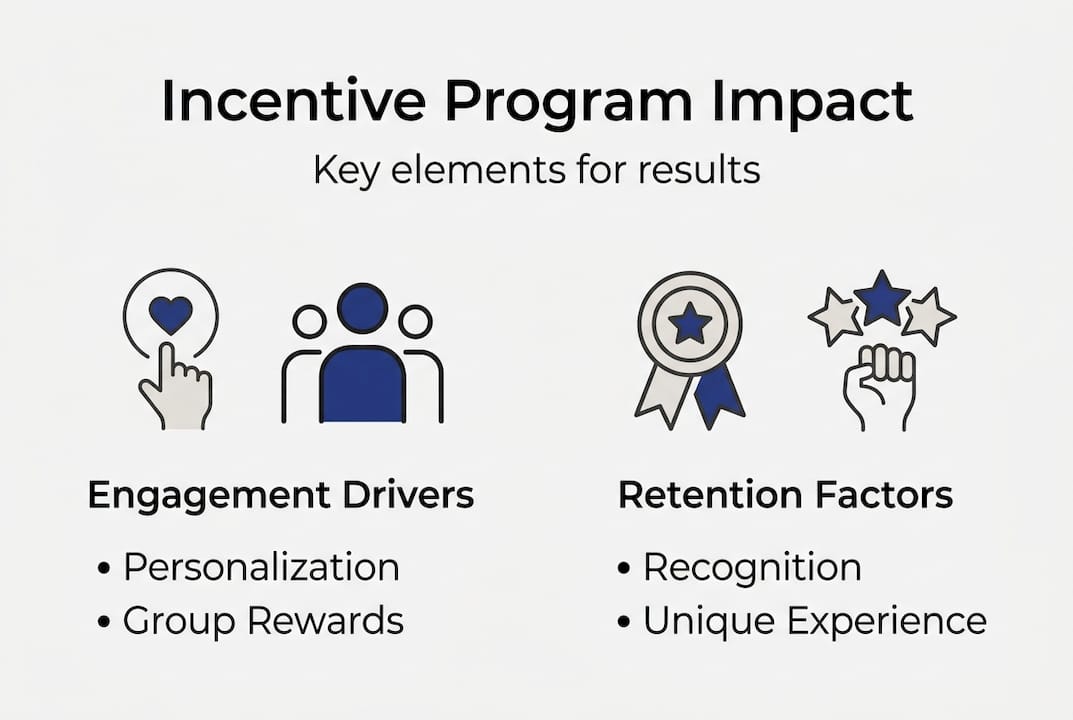
The data behind incentive travel is compelling. 81% of companies use incentive travel specifically for retention, travel rewards are 20% more effective than cash at reducing turnover, and 90% of winners report feeling more favorable toward their employer after the experience. These are not soft metrics. They translate directly to reduced recruiting costs and stronger performance cultures.
| Program element | Impact on engagement | Impact on retention |
|---|---|---|
| Personalized experience | High | High |
| Cash equivalent reward | Moderate | Low |
| Group recognition event | Moderate | Moderate |
| Individual travel reward | Very high | Very high |
Looking at 2026 trends, the IRF 2026 Trends Report highlights that 93% of incentive professionals are already using AI tools like ChatGPT to streamline program design, while sustainability and DEIB measurement are becoming standard expectations rather than optional add-ons. Cost pressures are real, but the organizations cutting corners on program quality are seeing diminishing returns.
Explore individual incentive travel solutions and the 2026 luxury guide to see how leading companies are structuring programs that hold up under budget scrutiny while still delivering exceptional experiences.
Choosing between group and individual incentive travel
Once you understand how programs are built, the next decision is structural: do you send your winners together, or do you give them the freedom to choose their own adventure?
Both models have genuine merit, and the right answer depends on your workforce, your culture, and what you are trying to achieve.
Group incentive travel delivers:
- Shared experiences that build team cohesion and cross-functional relationships
- Stronger brand moments, since your company controls the narrative of the entire trip
- Economies of scale that can stretch budget further per person
- Natural opportunities for leadership visibility and recognition ceremonies
Individual incentive travel offers:
- Flexibility for winners to travel when and where it suits their life
- Higher perceived value, since the experience feels personal rather than corporate
- Easier scaling across large or geographically distributed workforces
- Better accommodation of diverse family situations and personal preferences
Individual incentives scale better, drive 99% satisfaction rates, and see 85% of winners repeat their high performance in subsequent cycles. Those numbers are hard to ignore.
“The highest-performing incentive programs treat winners as individuals first, and employees second. That shift in perspective changes everything about how you design the reward.”
Hybrid models are gaining traction for exactly this reason. A company might host a group recognition gala at the destination while giving winners flexibility in their pre or post trip extension. This approach captures the brand moment of group travel while honoring individual preferences.
Factors to weigh when choosing your structure include budget per winner, the geographic spread of your eligible population, your culture around public recognition, and whether your goals are more team-oriented or individually focused. Resources like domestic vs. international travel, destination selection guidance, and group incentive options can help you pressure-test the decision before you commit.
The real value travel agencies can unlock
Here is the uncomfortable truth most articles skip: the majority of organizations are dramatically underusing their travel agency relationships. They treat agencies as commodity vendors, hand over a budget, approve a destination, and wait for the trip to happen. Then they wonder why the ROI is hard to quantify.
The agencies that deliver outsized value are the ones brought in as co-designers, not order-takers. That means involving them in your goal-setting conversations, sharing your HR data on what is actually driving turnover, and asking them to challenge your assumptions about what your employees want.
We have seen executives insist on European river cruises because they personally love them, only to discover through proper needs analysis that their workforce would have responded far more strongly to adventure-based experiences in a completely different region. The agency’s job, when given the right access, is to protect you from those expensive assumptions.
The organizations getting the best results from incentive travel in their business are the ones treating their agency partner the way they treat their best consultants: with full context, clear goals, and genuine collaboration. That relationship shift is where the real ROI lives.
Elevate your incentive program with a luxury travel partner
If you are ready to move beyond basic bookings and build a program that genuinely drives performance, the next step is finding a partner who thinks strategically from day one.
At Elite Travel Group, we design customized individual incentives and group programs that connect your business goals to extraordinary experiences. Whether your winners are dreaming of luxury Asia experiences or craving adventure travel packages that push boundaries, we build every itinerary with intention. With 35 years of expertise, no service fees, a price match guarantee, and 24/7 support, we are the strategic partner your incentive program deserves. Reach out today and let’s build something exceptional together.
Frequently asked questions
How do travel agencies support KPIs in incentive programs?
Specialist travel agencies design programs that align trips with your business goals, track ROI through defined metrics, and refine the approach based on post-program data. Generic agencies typically do not offer this level of strategic integration.
Are incentive travel programs really more effective than cash rewards?
Yes. Travel rewards outperform cash by 20% in reducing turnover, and 90% of winners report viewing their employer more favorably after the experience, making travel a stronger long-term investment.
What is the difference between individual and group incentive travel?
Individual travel drives 99% satisfaction and scales more easily across large workforces, while group travel creates shared experiences and stronger team cohesion. Many organizations use a hybrid of both.
How can HR and travel agencies work together for DEIB goals?
By co-designing programs with inclusion in mind and using digital tools to measure participation across demographics, agencies and HR teams can ensure DEIB goals are integrated into every stage of the incentive program, not just added as an afterthought.
Recommended
- Luxury Travel Agency For Individual Incentive Travel Vacation Packages | Elite Travel
- Luxury Travel Agency For Incentive Travel Vacation Packages | Elite Travel
- Company Incentive Program with Elite Travel | Elite Travel
- Luxury Travel Agency For Corporate Incentive Travel Vacation Packages | Elite Travel
