




TL;DR:
- Destination partnerships are collaborative alliances that boost a destination’s attractiveness and economy through coordinated efforts. These alliances, embedded in governance structures, generate measurable benefits like increased hotel sales and cultural sustainability. Effective partnerships require shared goals, transparent data sharing, and ongoing operational integration.
Destination partnerships are collaborative alliances between tourism stakeholders designed to amplify a destination’s attractiveness and economic value through coordinated marketing, management, and resource sharing. The role of destination partnerships goes far beyond co-branded brochures or joint social media posts. These alliances, formally structured under Destination Management Strategies (DMS), represent the core governance mechanism through which hotels, tour operators, local governments, and community organizations align their efforts toward shared growth. Collaboration is foundational for long-term resilience in travel and tourism. Elitetravelgroup has built its 35-year reputation on exactly this principle, working with trusted on-the-ground partners to deliver experiences that isolated operators simply cannot replicate.
What benefits do destination partnerships deliver to tourism and local communities?
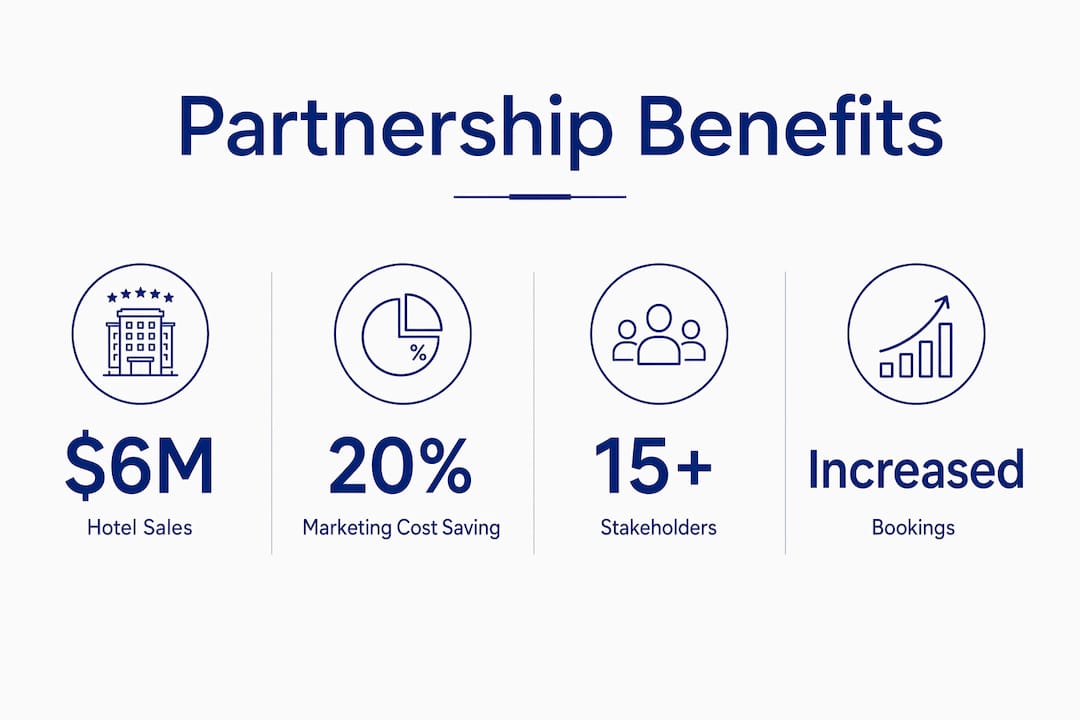
The economic case for destination collaboration is concrete and measurable. A regional cooperative marketing campaign called “Together at Last,” which united historically competing destinations, generated $6 million in hotel sales during a single campaign period. That result proves that pooling resources across competing destinations produces returns no single operator could achieve alone.

The benefits extend well beyond hotel revenue. Destination Management Strategies mediate the relationship between public-private partnerships and socio-cultural sustainability, meaning well-governed alliances protect local culture while driving economic growth. Communities gain shared responsibility for visitor management, which reduces the social friction that overtourism creates.
Marketing efficiency is another direct gain. When destinations share costs for visitor databases, printed guides, and digital content, each partner accesses professional-grade outputs at a fraction of the individual cost. Coordinated visitor data also sharpens product development, because partners can identify gaps in the experience and fill them together.
| Stakeholder | Primary benefit |
|---|---|
| Hotels and accommodations | Increased direct bookings and shared marketing reach |
| Local tour operators | Access to visitor data and cooperative promotional budgets |
| Community organizations | Socio-cultural protections and revenue-sharing agreements |
| Destination Management Organizations | Broader stakeholder alignment and stronger governance |
| Travelers | Richer, more cohesive destination experiences |
The table above reflects a consistent pattern: every stakeholder gains something distinct, and those gains reinforce each other. That interdependence is what makes well-structured destination collaborations durable.
How do destination partnerships function operationally and strategically?
Partnerships fail when they exist only on paper. Collaboration must be embedded into annual business planning to create long-term value. That means partnership goals appear in budget cycles, staff KPIs, and board-level reporting, not just in a memorandum of understanding signed at a conference.
Operationally, effective destination alliances run on four repeatable activities:
- Joint marketing campaigns. Partners pool budgets to fund campaigns that reach audiences none could afford to target individually. The “Together at Last” initiative is a documented example of this model producing measurable hotel revenue.
- Shared visitor databases. A centralized data asset lets every partner understand traveler behavior, spending patterns, and satisfaction scores. This replaces guesswork with evidence.
- Event collaboration. Co-hosted festivals, trade show appearances, and familiarization trips spread costs and amplify reach across the full destination network.
- Co-opetition frameworks. Competing communities pool resources for professional marketing assets, turning rivalry into collaborative advantage. Regional magazines, visitor guides, and digital content become shared infrastructure rather than duplicated expenses.
Governance matters as much as activity. DMS frameworks define who makes decisions, how conflicts get resolved, and how performance gets measured. Without that structure, partnerships drift toward the priorities of the most powerful partner.
Pro Tip: When launching a new destination alliance, communicate the “why” behind every shared initiative to local partners. Transparent communication of strategy bridges knowledge gaps and converts passive participants into active contributors.
What are effective strategies to create and maintain successful destination partnerships?
Building a destination alliance that lasts requires deliberate design from the first conversation. The following practices separate partnerships that produce results from those that stall after the launch announcement.
- Map stakeholders before you recruit them. Identify every organization that influences the visitor experience, from accommodation providers and transport operators to cultural institutions and community groups. Prioritize those whose goals overlap most directly with the destination’s growth targets.
- Align on shared goals in writing. Vague commitments dissolve under budget pressure. Specific, measurable targets, such as a defined increase in overnight stays or a target visitor satisfaction score, give every partner a clear reason to stay engaged.
- Share data openly. Sharing audience insights with local businesses turns passive partners into aligned stakeholders. When a small tour operator understands exactly which traveler segments are arriving and what they want, that operator can tailor its product and contribute more meaningfully to the overall destination offer.
- Build equity into contracts. Local hiring quotas, revenue-sharing agreements, and community veto rights prevent larger partners from capturing disproportionate value. These mechanisms are not optional goodwill gestures. They are the structural safeguards that keep smaller partners committed.
- Coordinate content across channels. A unified content calendar, shared photography assets, and consistent destination messaging across all partner websites multiply the reach of every individual piece of content.
Pro Tip: Avoid launching with too many partners at once. A tight founding group of four to six organizations with genuinely aligned goals builds faster momentum than a broad coalition that cannot agree on priorities.
The most common failure mode is power asymmetry. When one large hotel group or government body dominates the partnership, smaller operators disengage. Structured governance, including rotating leadership and equal voting rights on key decisions, counteracts this tendency before it becomes a crisis.
What challenges can arise in destination partnerships, and how can they be addressed?
Destination collaborations face predictable obstacles. Recognizing them early is the most effective mitigation.
- Power imbalances. Large operators naturally hold more resources and louder voices. Without contractual protections, community exploitation risks become real. Revenue-sharing clauses and community veto rights are the proven corrective.
- Misaligned stakeholder priorities. A luxury hotel group and a community cultural center rarely share the same definition of success. Facilitating a structured goal-alignment workshop at the partnership’s outset surfaces these differences before they become conflicts.
- DMO limitations in direct sales. Destination Management Organizations build awareness and coordinate strategy, but they do not typically close bookings. Hotels have lost approximately 80% of their distribution to online travel agencies. That figure underscores why DMO partnerships must focus on driving direct relationships between travelers and local operators, not just generating impressions.
- Sustainability drift. Partnerships that start with strong environmental and social commitments often dilute those commitments under commercial pressure. Embedding sustainability metrics into the annual reporting cycle, alongside revenue figures, keeps accountability visible.
- Fragmented execution. When each partner runs its own campaigns without coordination, the destination sends mixed messages to travelers. A shared editorial calendar and a single point of contact for media inquiries solve this at low cost.
Sister-city and regional twinning arrangements offer a proven governance model for addressing several of these challenges simultaneously. These formalized structures boost local GDP and infrastructure resilience when backed by institutional support, providing a template that destination marketers can adapt for their own alliances.
Key Takeaways
Destination partnerships deliver sustained tourism growth only when they are embedded in governance structures, funded through shared resources, and protected by contractual equity mechanisms.
| Point | Details |
|---|---|
| Economic impact is proven | Cooperative campaigns like “Together at Last” generated $6 million in hotel sales in a single period. |
| Governance drives outcomes | Destination Management Strategies mediate between partnerships and socio-cultural sustainability. |
| Data sharing activates partners | Transparent audience insights turn passive local businesses into aligned, contributing stakeholders. |
| Equity prevents collapse | Revenue-sharing agreements and local hiring quotas protect smaller partners from power asymmetry. |
| Embed partnerships in planning | Collaboration embedded in annual business plans produces long-term value; ad hoc efforts do not. |
Why I think most destination partnerships are set up to fail
After years of watching destination alliances form with great fanfare and dissolve quietly, I have reached an uncomfortable conclusion: most partnerships are designed for the launch, not for the long term. The founding MOU gets signed, the press release goes out, and then everyone returns to their individual priorities. The partnership becomes a logo on a website rather than a living operational structure.
The shift I have seen work is treating the partnership like a product with its own budget line, its own staff accountability, and its own performance review cycle. That sounds obvious, but the role of expert partnerships in travel planning is consistently underestimated until something goes wrong on the ground. The destinations that build real resilience are the ones where the hotel, the tour operator, and the local cultural organization have been in a room together recently, not just at the founding ceremony.
The other thing I would push back on is the assumption that more partners equals more strength. A tight network of four deeply committed organizations outperforms a loose coalition of twenty every time. Depth of alignment matters more than breadth of participation. Travel marketers who champion this approach, and who build the governance structures to support it, are the ones whose destinations hold up when conditions get difficult.
How Elitetravelgroup builds on destination partnerships
Elitetravelgroup has spent 35 years cultivating the on-the-ground relationships that make the difference between a good trip and an exceptional one. Every luxury adventure travel package Elitetravelgroup designs draws on a network of vetted local partners, from boutique hoteliers to specialist guides, who are aligned around delivering a single cohesive experience.

That network is not accidental. It is the product of the same partnership principles this article describes: shared goals, transparent communication, and mutual accountability. Elitetravelgroup charges no service fees and backs every booking with a price match guarantee, so you get the full benefit of those partnerships without paying a premium for access. Whether you are planning a milestone celebration or a curated group experience, the right local relationships are already in place.
FAQ
What is the role of destination partnerships in tourism?
Destination partnerships align hotels, tour operators, local governments, and community organizations around shared marketing and management goals. The result is a more cohesive visitor experience and stronger economic outcomes for all stakeholders.
How do destination partnerships create economic value?
Cooperative regional campaigns have demonstrated direct revenue impact, including $6 million in hotel sales generated through a single joint initiative between competing destinations. Shared marketing budgets and visitor databases multiply the return on each partner’s investment.
What is co-opetition in destination management?
Co-opetition is the practice of competing destinations or operators pooling resources for shared marketing assets, such as visitor guides and databases, that none could afford individually. It turns rivalry into a structural advantage for the entire region.
How can destination marketers prevent power imbalances in partnerships?
Contractual mechanisms including local hiring quotas, revenue-sharing agreements, and community veto rights are the proven tools for preventing larger partners from capturing disproportionate value. These provisions should be written into the founding agreement, not added later.
Why do destination partnerships fail?
Most partnerships fail because collaboration is treated as a one-time initiative rather than an ongoing operational commitment. Embedding partnership goals into annual business planning, staff accountability, and budget cycles is the structural fix that separates durable alliances from short-lived ones.
